
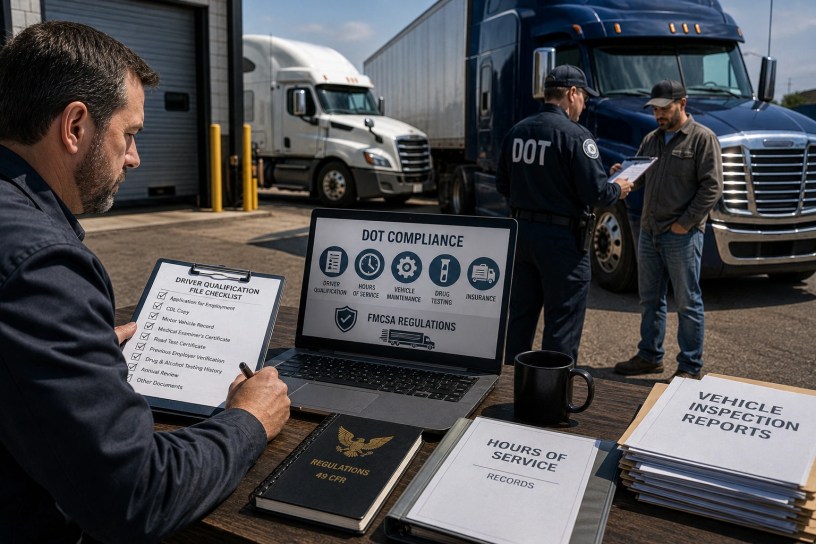
Operating a commercial fleet in the United States means operating inside one of the most heavily regulated business environments in any industry. The Department of Transportation and its enforcement arm, the Federal Motor Carrier Safety Administration (FMCSA), impose a comprehensive regulatory framework on carriers, fleet operators, and owner-operators that touches every aspect of commercial vehicle operations — from driver hiring and licensing through vehicle inspection, hours of service, drug testing, and insurance requirements.
For business owners who manage commercial vehicles as part of a broader enterprise — construction companies, distributors, agricultural operations, service businesses — the scope of DOT compliance obligations is frequently underestimated. Many discover the full extent of those obligations only after a roadside inspection generates violations, a safety audit reveals documentation gaps, or an accident triggers regulatory scrutiny that reveals systemic non-compliance.
Understanding what DOT compliance requires, how violations are measured and scored, and what the financial consequences of non-compliance look like is essential for any business operating regulated commercial vehicles. Here is a structured overview of what every fleet operator needs to know.
Who Must Comply with FMCSA Regulations
The first question many business owners ask is whether their vehicles actually trigger federal commercial vehicle regulations. The FMCSA’s regulatory scope is broader than most assume. Federal commercial vehicle regulations apply to any motor vehicle or combination of vehicles used in interstate commerce that meets any one of three criteria:
- Gross Vehicle Weight Rating (GVWR) or actual gross vehicle weight exceeding 10,001 pounds
- Designed or used to transport 9 or more passengers (including the driver) for compensation, or 16 or more passengers not for compensation
- Transporting hazardous materials in quantities requiring placarding under federal hazmat regulations
Interstate commerce is defined broadly — it includes any vehicle that crosses state lines, but also vehicles transporting goods that originated in or are destined for another state, even if the vehicle itself never crosses a state line. A delivery truck that stays within one state but hauls goods manufactured out of state may be subject to federal interstate commerce regulations.
Intrastate operations — vehicles that operate entirely within one state — are regulated by state DOT agencies, which typically mirror federal requirements to varying degrees. The practical implication is that most commercial fleet operators, regardless of their route patterns, operate under a comprehensive regulatory framework that requires systematic compliance management.
The CSA Scoring System: How the FMCSA Measures Your Safety Performance
The Compliance, Safety, Accountability (CSA) program is the FMCSA’s primary tool for measuring and publicly rating carrier safety performance. Understanding how CSA scores work is foundational to managing regulatory risk, because these scores affect insurance premiums, customer contract eligibility, roadside inspection frequency, and the likelihood of receiving a formal FMCSA safety audit.
CSA scores are calculated across seven Behavior Analysis and Safety Improvement Categories (BASICs), each measuring a different dimension of safety performance:
- Unsafe Driving: Speeding, reckless driving, improper lane changes, and other driver behavior violations
- Hours of Service Compliance: HOS violations, ELD non-compliance, and logbook falsification
- Driver Fitness: Invalid CDLs, expired medical certificates, and driver disqualification issues
- Controlled Substances/Alcohol: Drug and alcohol violations detected at roadside or through testing programs
- Vehicle Maintenance: Out-of-service violations for brakes, tires, lights, and mechanical defects
- Hazardous Materials Compliance: Placarding, packaging, and documentation violations for hazmat shipments
- Crash Indicator: Crash frequency and severity relative to miles traveled
Scores are percentile-based — carriers are ranked against peers with similar operational profiles, with 0 representing the best performance and 100 the worst. Scores above FMCSA’s intervention thresholds (which vary by BASIC category, generally 65 to 80 percent) trigger regulatory scrutiny, including compliance reviews and safety audits. Poor CSA scores are publicly visible through the FMCSA’s Safety Measurement System, which customers, brokers, and insurers routinely check before awarding contracts or quoting coverage.
Driver Qualification Files: The Most Common Audit Failure
Driver qualification (DQ) files are among the most frequently cited deficiencies in FMCSA compliance reviews — and the gaps are almost always administrative rather than substantive. Carriers know their drivers are qualified; they simply haven’t maintained the documentation that proves it.
Federal regulations under 49 CFR Part 391 specify what must be in every driver’s qualification file and how frequently it must be updated. Required elements include the employment application, a copy of the driver’s CDL, motor vehicle record (MVR) obtained at hire and annually thereafter, medical examiner’s certificate (with 45-day notification requirements for certificates with limitations), road test certificate or equivalent, previous employer verification (covering three years of safety-sensitive employment history and drug/alcohol testing results), and documentation of annual driver review.
Missing or expired DQ file documents generate per-driver violations during audits, and the fines accumulate quickly across a fleet of even modest size. A compliance review finding DQ file deficiencies in 10 driver files at penalties of $1,000 to $5,000 per violation becomes a significant financial event — one that systematic record management would have prevented entirely.
Hours of Service and ELD Requirements
Hours of Service regulations govern how long commercial drivers can drive and be on duty before mandatory rest periods are required. The core HOS rules for property-carrying drivers limit driving to 11 hours after 10 consecutive hours off duty, prohibit driving beyond the 14th hour after coming on duty, require a 30-minute break after 8 hours of driving, and limit weekly driving to 60 hours in 7 days or 70 hours in 8 days.
Electronic Logging Devices became mandatory for most interstate commercial carriers under an FMCSA rule fully implemented in 2019. ELDs automatically record driving time and duty status changes, replacing the paper logbooks that were prone to falsification and error. The mandate applies to most carriers operating vehicles requiring a CDL in interstate commerce, with limited exemptions for short-haul operators, driveaway-towaway operations, and vehicles manufactured before the year 2000.
For fleet operators implementing ELD systems or managing compliance for existing installations, understanding both the regulatory requirements and the operational best practices that maximize compliance efficiency is essential. A comprehensive guide to ELD compliance best practices covers device selection, implementation strategy, driver training requirements, and the operational integration that transforms ELD data from a compliance cost into a management tool.
Vehicle Maintenance and Inspection Documentation
The Vehicle Maintenance BASIC is consistently one of the highest-scoring categories for fleets that receive roadside violations — meaning it is one of the most common sources of CSA score deterioration and one of the most directly controllable.
FMCSA regulations under 49 CFR Part 396 require motor carriers to systematically inspect, repair, and maintain all commercial vehicles under their control. Specific documentation requirements include: a schedule of periodic inspections showing the type of inspection and frequency; records of all inspections, maintenance, and repairs including dates and nature of work performed; Driver Vehicle Inspection Reports (DVIRs) for pre-trip and post-trip inspections; and annual inspection reports retained for 14 months.
The regulatory framework does not prescribe specific PM intervals — carriers have latitude to design their own maintenance programs — but it does require that whatever program is established is documented and followed consistently. A well-structured preventive maintenance program that is rigorously documented provides both the mechanical protection that prevents violations and the audit trail that defends the carrier when a roadside inspection or compliance review occurs.
Drug and Alcohol Testing: Non-Negotiable Federal Requirements
Federal drug and alcohol testing requirements under 49 CFR Part 382 apply to all commercial drivers who operate CDL-required vehicles in interstate commerce. The testing program requirements include pre-employment testing for all new drivers, random testing at specified annual rates (currently 50 percent for drugs, 10 percent for alcohol), post-accident testing following qualifying crashes, reasonable suspicion testing based on supervisor observation, return-to-duty testing after violations, and follow-up testing for drivers who have completed return-to-duty requirements.
The FMCSA Drug and Alcohol Clearinghouse, operational since January 2020, requires carriers to query the database for all new CDL driver hires and annually for current drivers. The Clearinghouse records drug and alcohol violations, test refusals, and return-to-duty status — and carriers are legally prohibited from allowing a driver with an unresolved Clearinghouse violation to operate a CMV.
Non-compliance with drug and alcohol testing requirements generates some of the most severe penalties in the FMCSA’s enforcement arsenal. Operating a driver who has not been properly tested, or allowing a driver with an active Clearinghouse violation to operate, can result in per-driver fines, out-of-service orders, and in serious cases, carrier operating authority revocation.
Building a Compliance Management System That Works
The consistent theme across every compliance domain — driver qualification, hours of service, vehicle maintenance, drug testing — is that systematic documentation management is the foundation of regulatory defensibility. Carriers that maintain current, organized, complete compliance documentation pass audits efficiently and recover quickly from roadside violations. Those that don’t face penalties that compound rapidly across driver files, vehicle records, and testing documentation.
For fleet managers building or strengthening their compliance infrastructure, a structured overview of all FMCSA requirements, documentation standards, and best practices for each compliance domain is the starting point. The comprehensive FMCSA compliance requirements guide for fleet managers at Heavy Duty Journal covers the full regulatory framework — from carrier registration and operating authority through driver qualification, HOS management, and maintenance documentation — with practical implementation guidance for fleet operators at every scale.
The Financial Case for Proactive Compliance
DOT compliance has a cost — technology systems, administrative time, testing programs, training, and professional compliance support all require investment. But that investment is consistently less than the cost of non-compliance, which accumulates through per-violation fines, increased insurance premiums driven by poor CSA scores, lost freight contracts from customers who screen carrier safety ratings, and the operational disruption of out-of-service orders that ground drivers and vehicles at the worst possible times.
Fleet operators who treat compliance as a core business process — budgeted, staffed, and systematically managed — consistently operate at lower total cost than those who manage it reactively. The regulatory environment is not getting simpler, and the enforcement tools available to the FMCSA continue to become more sophisticated. Building compliance capability now is both a legal requirement and a competitive advantage.
About the Author:- Michael Nielsen is the editor and publisher of Heavy Duty Journal, a free digital trade publication serving diesel technicians, fleet managers, and owner-operators in the commercial trucking industry. He brings 15+ years of hands-on experience in diesel repair and fleet operations to HDJ’s editorial coverage.

